




Dynamic Difficulty Adjustment and Behavioral Control in Games
 Milijana Komad / 5 min read
Keywords: Dynamic Difficulty Adjustment, DDA, Video Gaming, Game Design, Player Behaviour
Abstract
Dynamic Difficulty Adjustment (DDA) refers to adaptive systems that fine-tune game difficulty in real time based on player performance. When implemented transparently and ethically, DDA enhances engagement, supports user motivation, and reduces frustration. However, covert or monetization-driven DDA can manipulate player emotions, increase spending pressure, and distort the perception of fairness. This paper examines DDA from behavioral, psychological, and product design perspectives, analyzing its mechanisms, real-world implementations, and ethical implications for contemporary game systems.
Introduction
Games are dynamic environments shaped by challenge, mastery, and reward. Difficulty is one of the primary levers through which designers calibrate the emotional pacing of gameplay. While fixed difficulty modes dominated early game history, modern live-service and algorithmic systems introduced adaptive frameworks capable of responding directly to user behavior.
Dynamic Difficulty Adjustment (DDA) represents this shift: instead of static challenge levels, the game continuously evaluates player performance and modifies difficulty to optimize emotional flow. This technique can enhance engagement — but it also introduces significant risks when difficulty changes are used to nudge players toward specific behaviors, such as spending on boosts or premium items.
Dynamic Difficulty Adjustment in Gaming: Core Concepts
1. Behavioral Feedback Loops
DDA systems adjust selected game variables in response to player performance or experience. Implementations may use rules, heuristics, or learning-based methods; predictive models are one possibility rather than a requirement. Variables that can be adjusted include enemy health, spawn rates, puzzle complexity, timing windows, and resource availability.
The design goal is often to balance challenge and perceived skill. Well-tuned DDA may support motivation and reduce frustration, although its effects depend on the game and the player.
2. Transparency vs. Covert Adjustment
Transparent DDA informs players when the game becomes easier or harder, supporting trust and agency.
Covert DDA hides its adjustments. While often subtle and effective, hidden difficulty manipulation can break immersion or create suspicion — particularly in competitive contexts or monetized environments.
Transparent DDA serves player experience.
Covert DDA can serve monetization.
Case Studies: DDA in Modern Game Design
1. Resident Evil 4 (Capcom, 2005)
One of the earliest well-documented implementations of DDA. The game dynamically adjusts enemy aggression, damage, ammo drops, and encounter patterns based on player performance. This subtle system ensures that newcomers do not become overwhelmed, while experienced players remain challenged.
2. Left 4 Dead (Valve, 2008)
Valve’s AI Director estimates Survivor intensity from events such as damage, incapacitation, ledge incidents, and nearby Infected deaths, then changes threat pacing. Valve’s Mike Booth describes this as adaptive dramatic pacing rather than adjustment of the underlying difficulty.

3. Mario Kart Series (Nintendo)
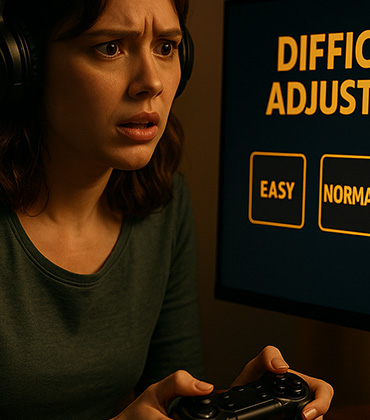
The well-known “rubber banding” system keeps races competitive by giving slower players advantageous items while increasing challenge for leaders. Though controversial, this approach supports accessibility and reduces early-race discouragement.
4. Potential Monetization Risks
A potential risk is that difficulty adaptation could be optimized for monetization, for example by increasing purchase pressure after failure. The possibility of such a design does not establish that particular games lower difficulty after purchases or engineer winning and losing streaks.
If used to create purchase pressure, difficulty adaptation could blur the line between adaptive design and behavioral manipulation.
Implementation in Product Design
DDA models are essentially algorithmic personalization. Outside gaming, similar frameworks appear in:
- adaptive learning platforms (edtech),
- fitness apps adjusting workout intensity,
- recommendation systems (content pacing),
- gamified productivity systems.
In product design, DDA correlates with personalized difficulty, task shaping, and micro-adaptive UX. The psychological foundation is consistent: calibrate challenge to keep users progressing.
Implications for User Behavior
- Increased Engagement: Properly balanced DDA prolongs gameplay and increases emotional investment.
- Enhanced Accessibility: Adaptive systems reduce entry barriers for inexperienced players.
- Risk of Manipulation: Covert adjustments can intentionally increase frustration to stimulate spending.
- Fairness Perception: Users may perceive competitive environments as “rigged” when DDA is hidden.
- Cognitive Fatigue: Invisible shifts in intensity can increase stress, particularly in monetized loops.
DDA must therefore balance personalization with transparency to maintain trust.
Ethical Considerations
- Disclose adaptive systems when used in monetized environments.
- Avoid frustration-based monetization.
- Allow players to toggle or limit DDA.
- Ensure competitive fairness — no hidden advantage or handicap.
- Use DDA to support mastery, not manipulation.
Ethical behavioral design recognizes that difficulty influences emotion, spending behavior, and long-term well-being. When DDA is used to deepen narrative immersion, support learning, or reduce barriers, it enriches gameplay. When used to extract revenue, it undermines autonomy.
Conclusion
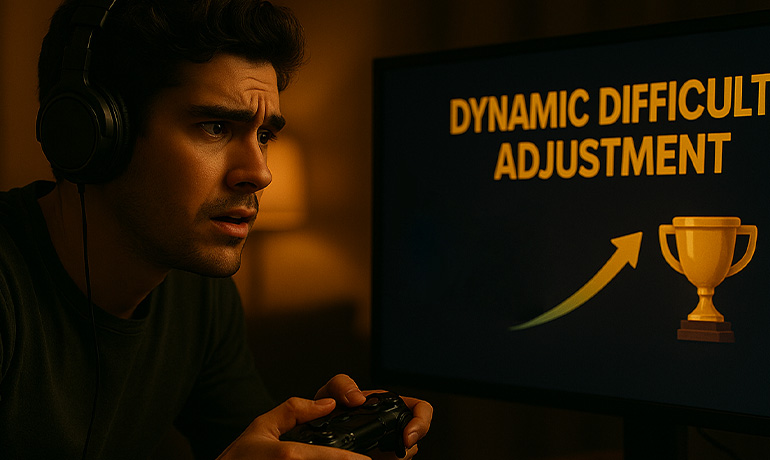
Dynamic Difficulty Adjustment is one of the most sophisticated and influential behavioral tools in contemporary game design. At its best, it supports accessibility, immersion, and emotional pacing — helping players enter and remain in the flow state. At its worst, it becomes an invisible instrument of manipulation, shaping difficulty not around enjoyment but around monetization.
The future of ethical game design depends on transparent adaptive systems that respect player autonomy. Designers hold the responsibility to ensure that difficulty responds to skill — not to spending patterns — and that the path through a game remains fair, meaningful, and grounded in genuine mastery rather than engineered frustration.
This article is part of a broader research series on behavioral manipulation in digital products.
For a comprehensive theoretical framework, see:
Engineering Behavior: Psychological Manipulation in Digital Products





Related posts

Behavioral Design

Behavioral Design
Locus of Control and the Illusion of Agency in Digital Products

Digital Monetization
Pay-to-Win Models and Monetized Power Asymmetry
DIGITAL DESIGN EXPERIENCE
MILIJANA KOMAD